What Is llms.txt? The Complete Guide to AI Search Optimization for Ecommerce Stores in 2026
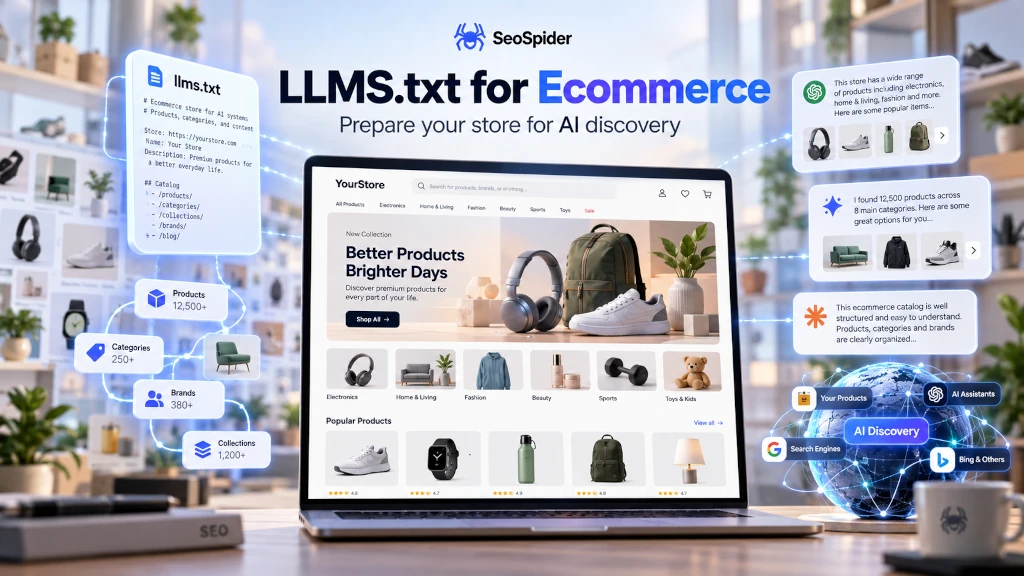
Introduction: Ecommerce Search Is Entering the AI Era
The way customers discover products online is changing.
For years, ecommerce businesses have focused on traditional search engine optimization (SEO), improving product titles, descriptions, keywords, backlinks, and technical website performance to appear in Google and other search engines.
Today, shoppers are increasingly using AI-powered assistants such as ChatGPT, Claude, Perplexity, and Google's Gemini to research products, compare alternatives, and make purchasing decisions.
Instead of searching for "best running shoes," a customer might ask:
"What are the best lightweight running shoes for someone with wide feet and a budget under $150?"
AI assistants can interpret these detailed requests and provide conversational recommendations.
For ecommerce merchants, this creates a new challenge: How can AI systems accurately understand your store, products, categories, and brand information?
One emerging approach is llms.txt, a proposed format designed to make website information easier for AI systems and agents to discover and interpret.
But what exactly is llms.txt, how does it work, and why does it matter for ecommerce stores with thousands of products?
Let's explore.
1. What Is llms.txt?
llms.txt is a Markdown-based text file that provides AI systems with a structured overview of a website and links to its most important content.
The proposal was introduced by Jeremy Howard, co-founder of fast.ai, in September 2024. An updated version of the specification was published in August 2026.
The concept is straightforward.
Traditional websites are designed primarily for human visitors. They contain navigation menus, interactive elements, images, JavaScript, and other components that make browsing convenient.
AI agents retrieving website information may need to process these elements before identifying the relevant content.
An llms.txt file offers a cleaner, more organized entry point.
Typically available at:
https://yourstore.com/llms.txt
The file can describe your business and provide links to important resources such as product collections, buying guides, policies, and company information.
For an ecommerce business, this might include:
- Brand identity and store description
- Major product categories
- Important products and collections
- Product buying guides and FAQs
- Shipping, returns, and customer support information
- Links to detailed product information
Rather than presenting every webpage indiscriminately, llms.txt provides a curated directory of information that an AI agent can choose to retrieve.
Important: llms.txt remains an emerging proposal, not a universally adopted AI-search ranking standard. Its usefulness depends on whether individual AI systems choose to discover and consume it.
Reference: Official llms.txt Specification
2. How Is llms.txt Different From robots.txt and sitemap.xml?
Ecommerce websites already use files such as robots.txt and sitemap.xml to communicate with search engines.
llms.txt serves a different purpose.
| File | Primary purpose |
|---|---|
| robots.txt | Provides crawling instructions for compliant bots |
| sitemap.xml | Lists important URLs to help search engines discover pages |
| llms.txt | Provides an AI-friendly overview and curated links to website content |
Consider an ecommerce store containing 15,000 products.
Its sitemap.xml may list thousands of product and category URLs, helping search engines discover them.
Its robots.txt may specify which areas crawlers should avoid.
Its llms.txt can introduce the business, explain its product categories, and point AI agents toward useful catalog information.
These files are complementary rather than interchangeable.
Importantly, llms.txt does not override robots.txt, grant crawling permission, or guarantee that AI platforms will read the content.
3. Why llms.txt Matters for Ecommerce Stores
Ecommerce websites are more complex than ordinary informational websites.
Products have names, descriptions, categories, prices, brands, variations, availability, and specifications.
Consider an electronics retailer selling 20,000 products across hundreds of categories.
A shopper might ask an AI assistant:
"Which wireless headphones under $200 support active noise cancellation and multipoint Bluetooth?"
To produce an accurate recommendation, an AI system needs reliable product information.
If information is difficult to retrieve, incomplete, or outdated, the resulting answer may be less useful.
An organized llms.txt resource can help participating AI agents locate relevant product categories, specifications, buying guides, and store policies.
Potential benefits include:
Clearer brand context: Explain what your business sells, its specializations, and the customers it serves.
Better content discovery: Direct compatible AI agents toward relevant products, categories, and educational resources.
Reduced ambiguity: Provide accurate descriptions and authoritative links rather than relying on scattered website content.
Preparation for emerging AI workflows: Establish a machine-readable information layer that future agents and tools may use.
However, these are potential operational benefits, not proven ranking improvements. There is currently no universal evidence that adding llms.txt alone increases AI citations, product recommendations, or sales.
4. What Should an Ecommerce llms.txt File Contain?
A useful ecommerce llms.txt file should be concise, accurate, and organized around customer-relevant information.
Here is a simplified example for a fictional electronics retailer:
# Nova Electronics

> Nova Electronics is an online retailer
> specializing in headphones, speakers,
> smart devices, and accessories.

## Product Categories

- [Headphones](https://example.com/headphones):
  Wireless, wired, and noise-cancelling headphones.

- [Smart Devices](https://example.com/smart-devices):
  Smart home products and connected accessories.

## Featured Products

- [Wireless Headphones](https://example.com/products/wireless-headphones):
  Over-ear headphones with active noise cancellation.

## Buying Guides

- [Headphone Buying Guide](https://example.com/guides/headphones):
  Compare features, connectivity, and fit.

## Store Information

- [About Us](https://example.com/about)
- [Shipping Policy](https://example.com/shipping)
- [Returns](https://example.com/returns)
The file provides a structured introduction without duplicating the entire website.
The official specification also supports links to Markdown versions of individual pages, allowing compatible agents to retrieve cleaner content.
For ecommerce stores, the challenge is not simply generating this file once.
The real challenge is keeping it accurate as the product catalog changes.
5. The Biggest Challenge: llms.txt for Large Ecommerce Catalogs
Creating an llms.txt file manually may be manageable for a small store with 20 products.
But what happens when a store has 5,000, 10,000, or 25,000 products?
Ecommerce catalogs change continuously.
New products are added, existing products are discontinued, categories are reorganized, descriptions are updated, and URLs occasionally change.
Manually maintaining a large llms.txt file quickly becomes impractical.
There are three important challenges.
Catalog Size
Listing every product inside a single llms.txt file can create an unnecessarily large document.
AI agents benefit from relevant, well-organized information, not necessarily an enormous list of every URL.
A better approach is to prioritize important categories, featured products, and buying guides, with links to more detailed resources.
Catalog Accuracy
A file that references discontinued products or outdated URLs can become misleading.
For AI discovery, accurate product information is more valuable than simply publishing a large quantity of content.
Ongoing Maintenance
Every catalog update potentially creates additional work.
For a merchant managing thousands of SKUs, manually synchronizing AI-friendly information with the live store is not sustainable.
This is where ecommerce-specific automation becomes valuable.
6. How SeoSpider Simplifies llms.txt for Large Ecommerce Stores
SeoSpider is an all-in-one ecommerce SEO and image optimization platform designed for BigCommerce and Ecwid merchants.
Its llms.txt capability helps merchants prepare structured store information for emerging AI discovery workflows without manually building and maintaining complex files.
Unlike manual llms.txt generators, SeoSpider is designed around the structure and scale of ecommerce catalogs.
Built for Large Product Catalogs
SeoSpider works with ecommerce product data, categories, and store information, making it suitable for merchants managing hundreds or thousands of products.
Instead of manually collecting URLs and writing descriptions for individual products, merchants can use an integrated store optimization workflow.
For large catalogs, the objective is to provide organized, relevant information rather than overload a single llms.txt file with every SKU.
Less Manual Maintenance
Large ecommerce stores need repeatable processes as products and categories change.
SeoSpider's broader automation capabilities help merchants maintain SEO information at scale, reducing the need for repetitive manual updates.
The llms.txt workflow complements this approach by making structured store information easier to manage.
SEO and AI Discovery in One Platform
llms.txt is only one component of preparing an ecommerce store for modern search.
SeoSpider also provides:
- AI-powered SEO auditing
- Bulk SEO title and meta description optimization
- Contextual image alt text generation
- Image compression and optimization
- Automated SEO workflows
- Technical SEO issue detection
- IndexNow and rich snippet capabilities
This integrated approach is especially useful for larger catalogs where optimizing individual pages manually can consume significant time.
The advantage is scale: merchants can manage traditional SEO improvements alongside emerging AI-discovery preparation without relying on disconnected workflows.
7. Does llms.txt Improve Rankings in ChatGPT, Gemini, or Google?
This is one of the most important questions merchants should ask.
The answer requires separating potential benefits from confirmed platform behavior.
The official llms.txt proposal describes how AI agents can discover structured website information. However, publishing the file does not mean every major AI platform will use it.
Google explicitly states that Google Search, including its generative AI capabilities, does not use llms.txt as a special signal. Maintaining the file neither improves nor harms Google Search rankings.
Similarly, there is no universal commitment that ChatGPT, Claude, Perplexity, or other assistants will consult every merchant's llms.txt file when generating shopping recommendations.
Therefore, businesses should not treat llms.txt as a shortcut to AI visibility.
Instead, consider it an additional AI-readiness layer alongside established practices such as crawlable product pages, accurate structured data, useful content, and reliable product information.
For ecommerce merchants, the sensible approach is to improve proven SEO foundations while experimenting with emerging AI discovery formats.
Reference: Google Search Central: Optimizing for Generative AI
8. llms.txt, Structured Data, and IndexNow: A Broader Discovery Strategy
Preparing an ecommerce store for search requires multiple complementary technologies.
llms.txt provides an organized directory of website information for compatible AI agents.
Structured data uses formats such as Schema.org Product and Offer markup to describe products, prices, availability, and other attributes in machine-readable form.
Google documents how Product structured data can make eligible pages available for merchant listing experiences.
IndexNow provides a mechanism for notifying participating search engines when URLs are added, updated, or deleted. It is not a guarantee of indexing.
These technologies address different problems.
For example, when a merchant launches a new product, structured data can describe its attributes, IndexNow can notify supported search engines about the updated URL, and a maintained llms.txt resource can help compatible agents navigate relevant store information.
SeoSpider brings these capabilities into a broader ecommerce optimization workflow.
References: Google Merchant Listing Structured Data and IndexNow Official Documentation.
9. Best Practices for Ecommerce AI Search Readiness
Whether your store has 100 products or 25,000, start with these principles.
Maintain accurate product information. Product titles, specifications, availability, and descriptions should reflect what customers can actually purchase.
Prioritize important catalog pages. Feature meaningful categories, popular products, and helpful buying guides rather than filling llms.txt with thousands of unorganized links.
Keep URLs accessible and consistent. Broken links, unnecessary redirects, and inaccessible pages make information retrieval harder.
Implement appropriate structured data. Product and Offer markup can help eligible ecommerce pages participate in supported Google Search experiences.
Automate repetitive optimization. Large catalogs benefit from bulk metadata updates, contextual alt text, image optimization, and ongoing technical auditing.
Monitor and validate changes. Check that your llms.txt file remains publicly accessible and correctly formatted, and that its linked pages remain current.
The strongest strategy combines reliable product information, good technical SEO, and structured content that both people and automated systems can understand.
10. Getting Started With SeoSpider
For BigCommerce and Ecwid merchants, SeoSpider provides a practical starting point for improving store-wide SEO and preparing for emerging AI discovery requirements.
Rather than treating llms.txt as an isolated technical exercise, merchants can incorporate it into their existing catalog optimization strategy.
With SeoSpider, store owners can address common SEO issues, optimize product metadata in bulk, generate contextual image alt text, improve image performance, and manage AI-discovery-related capabilities within one platform.
This is particularly valuable for stores managing thousands of products, where manual optimization and ongoing maintenance are costly and time-consuming.
Conclusion: Prepare Your Ecommerce Store for AI Discovery
AI-powered product research is creating new opportunities and challenges for ecommerce merchants.
llms.txt represents an emerging approach to making website information easier for AI agents to discover and interpret.
Although it is not currently a confirmed ranking factor for major search platforms, it can serve as a useful, structured information resource for systems that support it.
For smaller stores, creating a basic llms.txt file may be relatively straightforward.
For larger ecommerce businesses, however, maintaining accurate information across thousands of products requires a more scalable approach.
SeoSpider helps bridge that operational gap by combining ecommerce SEO automation, large-catalog optimization, and emerging AI-discovery capabilities in one platform.
Traditional SEO remains essential. AI discovery is an additional area worth preparing for.
Ready to optimize your ecommerce store for today's search engines and tomorrow's AI-powered shopping experiences?
Explore SeoSpider and discover how automated SEO optimization can simplify managing even your largest product catalogs.
References and Further Reading
- Official llms.txt Specification – Jeremy Howard and the llms.txt proposal.
- llms.txt Specification Changes – August 2026 updates.
- Google Search Central: AI Optimization Guide – Official guidance on AI features and llms.txt.
- Google Merchant Listing Structured Data – Product and Offer markup.
- Google Ecommerce Site Structure – Catalog navigation and discoverability.
- IndexNow – Official URL notification protocol.